
A customer has paid 49 € a month for their e-bike for four months. They ride it every day and they like it. If someone offered, they’d buy it. Nobody offers, so the subscription runs until one day it ends and the bike comes back to stock.
That’s a lost sale. A subscriber is the best possible buyer for that exact item: they’ve been testing it for months.
Rent-to-own is a sale of something the customer already has.
Rent-to-own, rent-to-buy, subscribe-to-buy: the names vary, and people use “rent” and “subscribe” for the same thing here. The customer pays monthly for an item and can buy it to keep. This tip uses them interchangeably.
Nothing is delivered and nothing comes back. Only the owner changes. Here’s how to do it by hand on TWICE Commerce, where the manual path breaks, and the order of steps that catches people out.
Why a buy-out makes sense
A monthly subscription works for both sides: the customer doesn’t pay everything at once, and you get steady income. Sooner or later, though, the item has paid for itself, and the customer has paid a good share of its price.
At that point there are three options. The subscription runs on; it ends and the item comes back to stock as used; or the customer buys it. The third is often the best: you get the sale price now, the customer gets their own, and you don’t have to service and re-rent a used item.
It also works the other way round, as a way to sell expensive equipment. A 2 000 € e-bike is a big decision in a shop. At 49 € a month it is an easy one: the customer tries the bike in their own daily life first, and buys it once they know it fits. Subscribe first, buy later lowers the threshold for your most expensive items, and you can say so in your store.
A fair price is easy to explain: the sale price minus everything the customer has already paid on the subscription, but never below an agreed floor, say 20 % of the sale price. The price drops every month, and the customer can see it.
Can TWICE Commerce do this?
TWICE Commerce has subscriptions: a price, a payment cycle, a commitment period and automatic billing. It also has sales, checkout links, and individual items with their own history. So all the pieces are there.
What it doesn’t have is a buy-out as one action. Turning a subscription into a sale of the same item takes several manual steps, and nothing offers the buy-out to the customer.
A buy-out also needs every item to be tracked individually. If that difference is unclear, read serialized or pooled inventory first.
The manual path
When a customer asks whether they can buy the bike:
- Work out the price: the sale price minus the subscription invoices they’ve paid.
- Add a sale line to the order at that price, and send the customer a checkout link for that line only.
- Once paid, end the subscription straight away.
- Move the same item onto the sale line.
- Mark the sale line as handed over and the old subscription line as returned.
It works when you have a few buy-outs a year.
Where it falls short
Nobody asks. The manual path only starts if the customer asks. Most don’t. A sale nobody offers doesn’t happen.
The price is worked out by hand. You go through the invoices one by one, and the price is right only on that day.
TWICE Commerce’s own emails confuse the buyer. After paying, the customer gets an order confirmation that still shows the next monthly payment, and soon after an email saying “your subscription has been cancelled”. A buyer reads that as a termination.
A buy-out that offers itself
This is the version we built. Everything still happens in TWICE Commerce, but the offer goes out by itself, and the steps run in the right order.
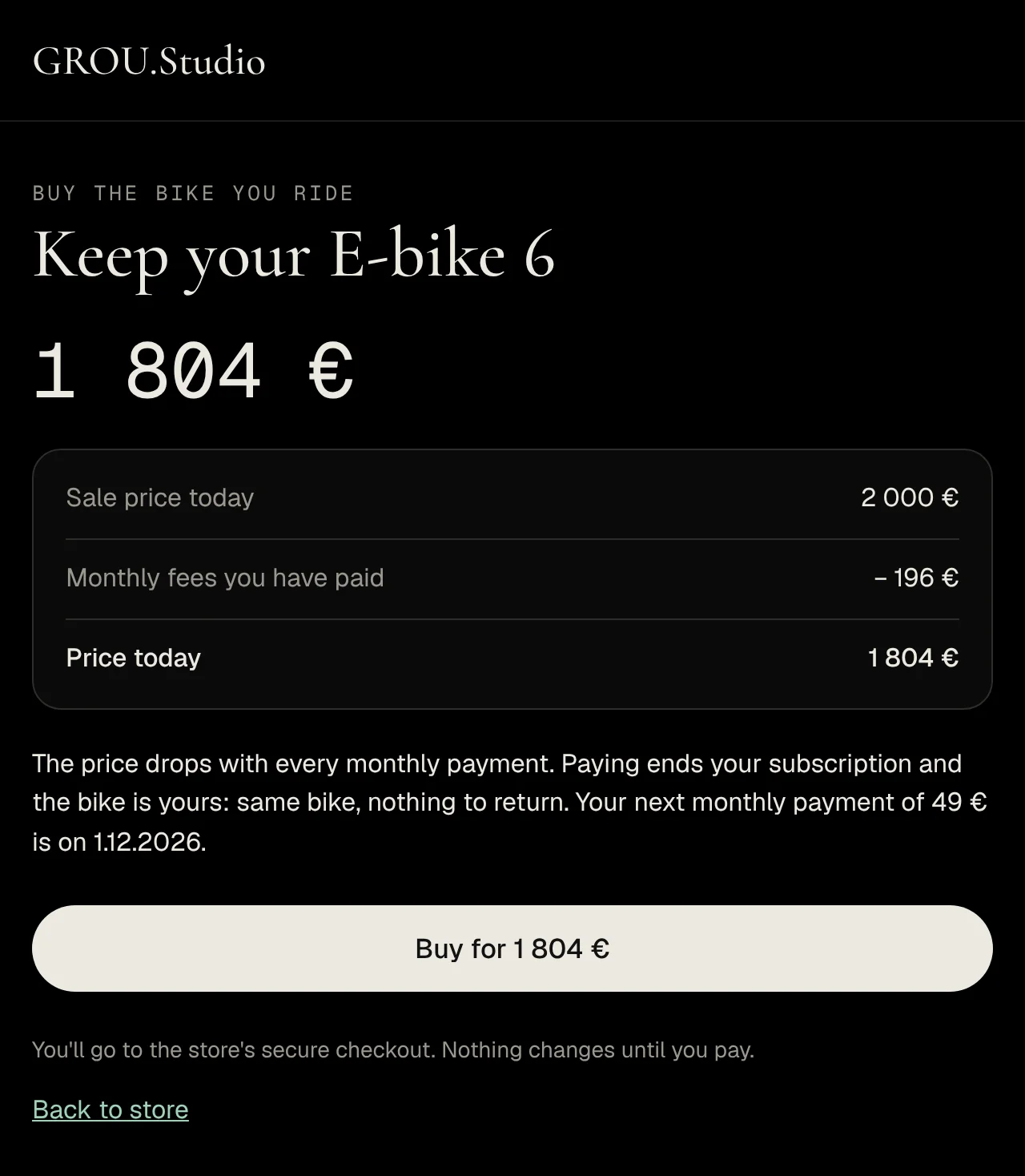
- After the first monthly payment, the customer gets an email: “You can buy this bike.” It has one link that always shows today’s price.
- A reminder goes out 7 days before every monthly payment.
- You set the sale price per item or per product type in TWICE Commerce, and change it any time.
- The customer clicks Buy and pays in your normal TWICE Commerce checkout.
- Only after payment is the subscription ended and the same item moved onto the purchase. If the customer doesn’t pay, nothing changes.
You can subscribe to a demo bike with a test card and see the buy-out offer yourself from the subscribe-to-buy page.
The part that trips everyone up: the order
A buy-out has three steps: the money, ending the subscription, and moving the item. We tried every order on a TWICE Commerce test store, and only one works cleanly.
- You can’t put the item on a sale line while the subscription runs. A subscription holds the item with no end date, so TWICE Commerce refuses a second booking. That’s correct: the same bike can’t be in two places.
- If you end the subscription first, the risk is yours. If the customer then doesn’t pay, the subscription is already gone.
- If you turn the subscription line straight into a sale and end the subscription afterwards, the item is released. The sold bike shows as available again, and someone can book it.
Money first, then end the subscription, then move the item.
In that order, the subscription isn’t touched until the money is in, and the sold item stays sold.
What to decide before you start
- Sale price. What would you sell this item for today? Update it as the item ages.
- Floor. What’s the lowest price you’ll sell at, however much the customer has paid? 20 % of the sale price, for example.
- Commitment period. Can someone buy during a minimum term? Usually yes: the purchase replaces the commitment.
- Emails. Adjust the wording of TWICE Commerce’s order confirmation and cancellation emails so a buyer knows they’ve bought.
- Tax. VAT and the margin scheme for used goods are your store settings. Ask your accountant before the first buy-out.
Common mistakes
Waiting for the customer to ask. Most won’t. The offer has to come from you.
Ending the subscription before payment. If the payment never comes, you’ve lost both the subscription and the sale.
A new item from stock. The customer wants the bike they already ride, not a new one. Same item, nothing to return.
A few common questions
Does TWICE Commerce have subscriptions? Yes: a price, a payment cycle, a commitment period and automatic billing. A buy-out as one action isn’t part of them.
Can a customer buy during a minimum term? You decide. The most common choice is that the purchase replaces the commitment.
How is the buy-out price worked out? The simplest fair model: the sale price minus everything paid on the subscription, never below an agreed floor.
Does this help sell expensive items? Yes. The customer can try the item on a monthly fee first and buy it later, with what they’ve paid taken off the price. That’s a smaller step than paying the full price up front.
Does this work for things other than bikes? For anything you offer on subscription as individual items: furniture, tools, electronics, sports gear.
The One-Sentence Summary
If you remember one line:
A subscriber is the best buyer for the item they already use — TWICE Commerce has every piece a buy-out needs, but someone has to make the offer, and the steps have to run in order: money first, then end the subscription, then move the item.
We set up buy-outs on TWICE Commerce stores, with an offer that sends itself and a price that drops every month. Try the demo and see if it fits your store.