
A customer brings the bikes back. The day went well, the weather held, and at the counter they say they’ll be back. Then they go home, and nobody reminds them until next summer.
A discount code for next time is an old way to bring customers back. In a rental business, what matters is the moment it arrives.
The best moment to ask a rental customer back is when they return the gear — not when they order.
When they order, they haven’t experienced anything yet. When they return, they’ve just had a good day. Here’s what TWICE Commerce does with discount codes on its own, the quick workaround, and the part that catches people out.
What TWICE Commerce discount codes can do
TWICE Commerce has proper discount codes:
- Amount. A percentage or a fixed amount in euros, off the whole order or per item.
- Usage limit. How many times the code can be used in total.
- Validity. A start and an end date.
- Scope. What the code works on: rentals only, certain listings or collections, or a certain location.
What it doesn’t have is automation. TWICE Commerce doesn’t create a code per customer, and it doesn’t send a code by itself when an order moves on.
The quick workaround: one shared code
- Make one code, say COMEBACK: 10 € off, valid to the end of the year, rentals only.
- Print it on a card you hand over at return, or add it to the messages you send customers.
It takes an afternoon and beats nothing.
Where it falls short
A shared code spreads. When everyone has the same code, it ends up with friends and on coupon sites sooner or later. The usage limit counts the code in total, not per customer.
You can’t see who came back. With one code for everyone, you can’t tell whether the thank-you brought back the customers you gave it to.
A code per customer is handwork. You can do it by hand: check returns every day, make a code, send an email. In a busy week it doesn’t happen.
A code that sends itself at the right moment
This is the version we built. The codes are still ordinary TWICE Commerce discount codes, but every customer gets their own, and it goes out by itself.
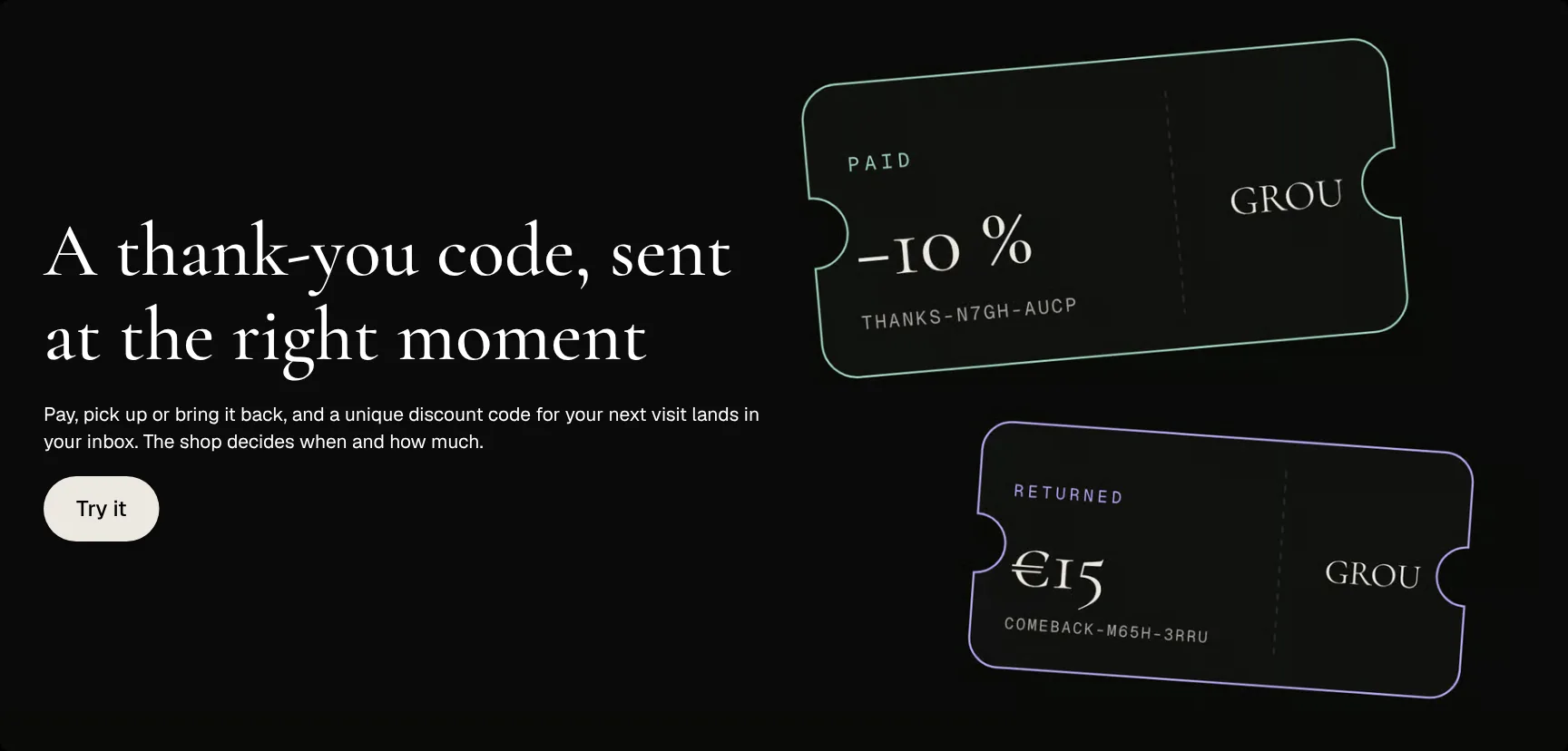
- When. You pick the moment: when the order is paid, when the gear is picked up, or when everything is back.
- Who. Rules can look at the order value, the product, the channel, the rental length, or whether it’s the customer’s first order.
- How much. A percentage, a fixed amount, a share of this order’s value, or steps: 10 € off the next rental, or 15 € if this one was 60 € or more.
- How. The code is the customer’s own and works once. It’s saved on the order and sent with your own TWICE Commerce email template, in the customer’s language.
- Test run. Type an order number and see which rules would fire, without sending anything.
- One product. 20 % on the cargo bike, or no code at all — you change it in TWICE Commerce itself, without touching the rules.
You can try it on a real TWICE Commerce test store from the discount codes page. Rent a bike with your own email address and the code arrives a moment later.
The part that trips everyone up: unique isn’t personal
When every customer gets their own code, it’s easy to assume the code only works for them. It doesn’t. A TWICE Commerce discount code isn’t tied to a customer. A single-use code works once, but whoever has it can use it.
In practice that’s rarely a problem. If a customer gives their code to a friend, you’ve got a new customer. Two things are still worth knowing:
- A code can’t have a minimum order. If 15 € off should only apply to rentals of 60 € or more, say so in the email. The code itself won’t enforce it.
- Size the amount for that. Because the code is single-use, the worst case is one discount for the wrong person. Keep the amount at a level where that’s fine.
A unique code is single-use, not personal — size the amount so it’s fine whoever uses it.
What to decide before you start
- The moment. For rentals, the return. For sales, the payment. You can use both at once.
- The amount. A fixed amount reads more clearly than a percentage: “15 € off your next rental”.
- Validity. Long enough to reach the next season. A year for summer renters.
- What it works on. Rentals only, if you don’t want the code used on product sales.
- The message. A short thank-you and the code. Not a newsletter.
Common mistakes
Sending the code at order time. It feels more like a price cut than a thank-you, and some customers spend it straight away on another order.
Too short a validity. A code given in June that expires in August brings nobody back next summer.
One code for everyone, forever. A shared code is a fine start, but change it at least once a season.
A few common questions
Can TWICE Commerce send a discount code automatically? Not on its own. Codes are made in the admin and sent separately. An automatic code per customer is added as a custom solution.
Can a code be limited to rentals? Yes. A TWICE Commerce discount code can be scoped to a purchase type, listings, collections and locations.
Can a discount code have a minimum order value? No. If you want a minimum, say so in the email.
Can one order give a customer two codes? Yes, if two rules fit — one when they pay and another when they return, for example.
What about gift cards? A gift card is money someone has already paid; a discount code is a thank-you. Read about gift cards for a rental business.
The One-Sentence Summary
If you remember one line:
Rental customers are most likely to come back when the thank-you arrives at return — TWICE Commerce discount codes handle the amount, scope and usage limit, but a code per customer at the right moment needs automation.
We set up automatic discount codes on TWICE Commerce stores, sent after payment, pickup or return. Try the demo and see if it fits your store.