You rent a “Party Set” — one table and six chairs — for €90 a weekend. The customer wants one product, one price, one date to remember. Easy. But come reporting time you want the other half of the story: of that €90, how much did the table earn, and how much the chairs? Which part of the set actually pays for itself?
In TWICE Commerce a bundle handles both at once — the simple thing the customer sees, and the per-item accounting you need behind it.
A bundle is one price the customer pays — and a set of rules that decide which items get reserved, and how that one price is shared back to each of them.
Two parts, then: the rules, and the share.
A bundle is one Listing with several rules
A bundle isn’t a special product type. It’s an ordinary Listing whose Fulfilment tab carries more than one rule — each rule reserving a different kind of stock.
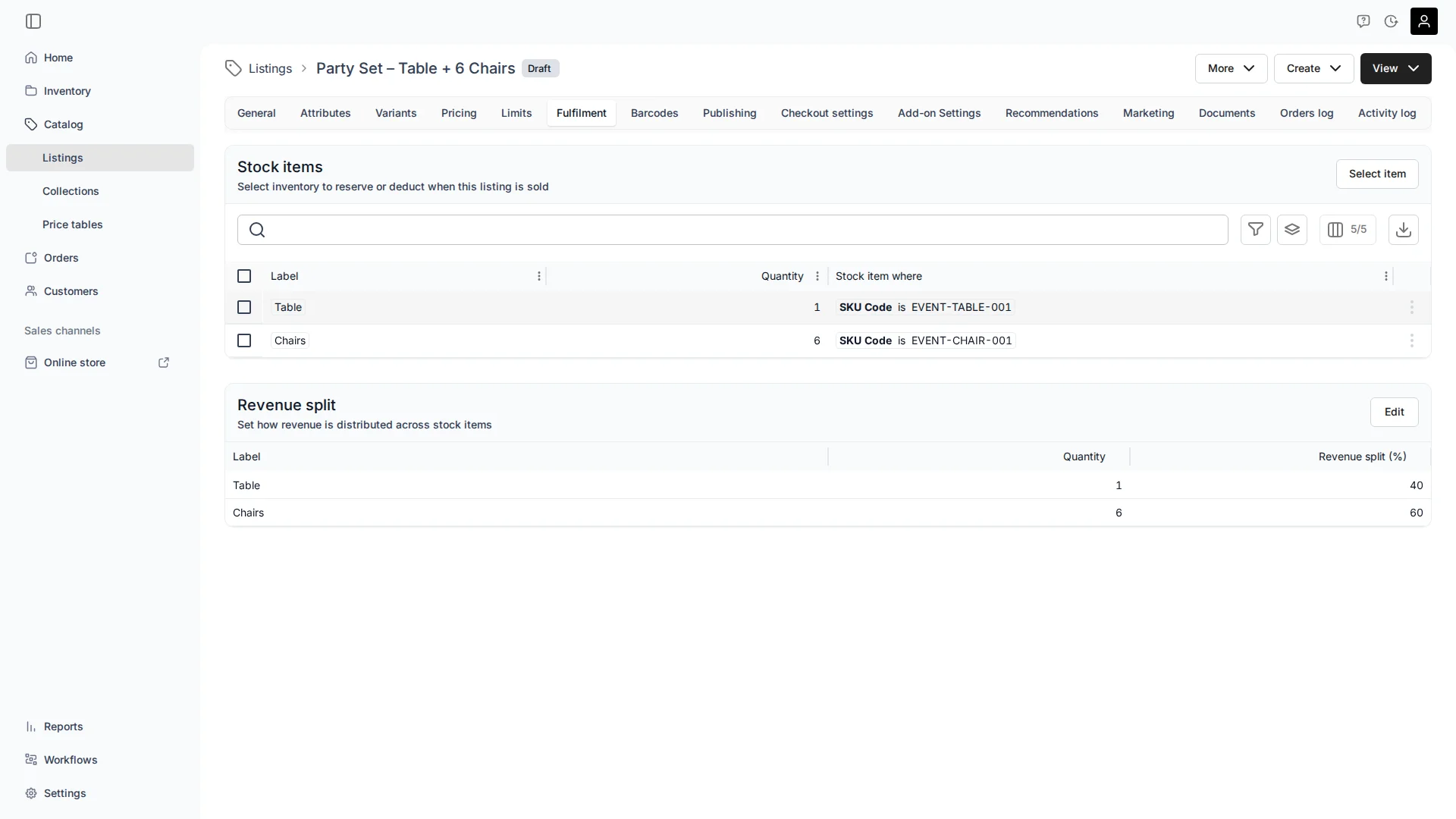
Two rules on the Party Set: reserve 1 item where SKU Code is EVENT-TABLE-001, and 6 where SKU Code is EVENT-CHAIR-001. The customer sees one product at one price; at checkout, seven physical items get committed. And because availability is computed from the rules, if any one of them — the table or a single chair — is short for the requested dates, the whole bundle shows as unavailable. (More on rules and the three-layer model in Listings, SKUs, and Stock Items.)
Revenue split: share the price back to the items
Right under the rules sits Revenue split — “set how revenue is distributed across stock items.” Each rule gets a percentage, and the percentages add up to 100. That’s how the single bundle price is attributed back to the components.
On the Party Set the table is 40% and the chairs are 60%. So a €90 weekend booking splits like this:
- Table: 40% → €36
- Chairs: 60% → €54, across 6 chairs = €9 each
That share flows into each component’s income — the same per-item ledger that records every euro a Stock Item earns and every euro it costs. The customer still pays one price of €90; the split just decides how that €90 is credited internally.
Why bother splitting?
Because “the Party Set made €90” tells you nothing about what to buy more of. Per-item earnings do.
Track it for a season and you might find the chairs are run ragged at €9 a head while the table sits comfortably — so the next purchase is more chairs, not another table. Or that the table carries the set and the chairs barely move. Revenue share turns a bundle from an accounting blind spot into per-item signal: which components earn their keep, which to restock, which to retire.
Pooled or serialized chairs?
There’s a wrinkle worth knowing. Per-item profitability only works when an item is tracked individually (serialized). If your six chairs are a single pooled record of quantity 6, the 60% lands on the pool as a whole — you’ll know the chairs earned €54, but not which chair. Serialize them and each gets its own slice and its own lifetime ledger.
For low-value, interchangeable chairs, the pool is usually the right call; for a signature item, serialize it. That trade-off is the whole subject of Serialized or Pooled Inventory.
The thing that trips people up
Revenue split is about attribution, not the price tag. It never changes what the customer pays — that’s still the single bundle price set on the Pricing tab (often a fixed package price, like €90 for a weekend). The split only decides how that amount is credited across the items behind the scenes, for your reports and each item’s ledger.
Two more: the rates add up to 100% across the rules, and like every pricing change, editing the split only affects future orders — bookings already taken keep the attribution they captured at checkout.
A few common questions
Does revenue split change the customer’s price? No. They pay the one bundle price. Split only decides how that revenue is credited across the components internally.
How is the bundle priced, then? On the Listing’s Pricing tab, like any Listing — commonly a fixed package price (e.g. €90 for a 3-day weekend). See Advanced Pricing Rules for fixed packages.
Do the percentages have to total 100? Yes — the split distributes the whole bundle price across the rules.
What if a chair in the set isn’t available? The bundle is unavailable for those dates. Availability is computed from all the rules, so every component has to be free.
Can I see each item’s share? Yes, on each Stock Item’s income ledger — provided the item is tracked individually. Pooled stock shows the share for the pool, not per unit.
If I change the split, do past bookings move? No. Existing orders keep the attribution captured at checkout. Edits affect future orders only.
The One-Sentence Summary
If you remember one line:
A bundle is one Listing with several fulfilment rules and a revenue split — the customer pays one price, and that price is shared back across the items so each one’s earnings are real.
Designing a set so the accounting is honest — which items to bundle, what split reflects reality, and which components to serialize — is one of the things we work through in a setup session, so your bundles look simple out front and stay legible in the books.